Overview
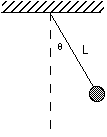
A simple pendulum consists of a mass suspended from a string of length L. When this pendulum oscillates back and forth about its equilibrium position the period (T) for one complete cycle is given by:

where g is the acceleration due to gravity. At the surface of the Earth g has the value:

Later in the semester we will derive this expression for the dependence of period on length. The assumptions made are that the maximum angle that the string makes with the vertical is small so that to a good approximation:

Under this assumption the period is independent of the maximum angle. We also assume that the string is massless - all the mass is in the object hanging off the end of the string. Notice that the period does not depend on mass.
Object
The object here is to measure the period using a watch, for various lengths of a simple pendulum. We will provide string, a ruler and an object to hang from the string.
In order to get an accurate estimate of the period you should measure the total time for the pendulum to oscillate for N (e.g. N = 5 or 10) complete cycles to get the average time for one cycle.
Use IGOR to make a plot of period vs time. Make sure you estimate the error in your measurement of the period. This takes some thinking.
What to Read
- lab1.doc - a Word document giving some information on measurements made by Alex
- Igor1.doc - a Word document - a tutorial on using IGOR to plot your data
- Guidelines - for your website and report
- Notes from U of Michigan - on error analysis
- My optics course notes - on error analysis