Website
Everyone must have a separate web page for P221 Honors Physics lab reports and other assignments. Your page should follow this template. Note the following:
- Include your name and e-mail address
- For each lab give the date and and name of your lab partner
- The report should be submitted as a Word document
- Accompanying files (e.g. IGOR, Mathematica, etc.) should be bin-hexed using Drop Bin
Since I will often be downloading your reports and files via a modem connection it is essential that you keep the website simple - so follow the template. Also, since I will be visiting up to about 20 sites for each lab, I want to be able to find material quickly and easily. This is another reason to follow the template.
Filenames: Please use the following filename format for your Word document files and other files:
lab1_ad_dh.igor.hqx
Note the format for filenames:
- no spaces
- lab1 (or 2 or 3) followed by the initials of the authors
- .doc for word documents and .igor for IGOR. Note that Drop Bin automatically appends the .hqx extension
Each student must have a link on his/her webpage for each report - even if you collaborate with your partner on a report.
Guidelines for
the Website
The preparation of technical documents is an important skill for anyone who plans to work in the sciences. You will find that organizations, journals and professional conference proceedings require you to follow specific templates for notes or papers. Indeed many times contributions are to be submitted as Microsoft Word documents.
The form of the report should follow this outline:
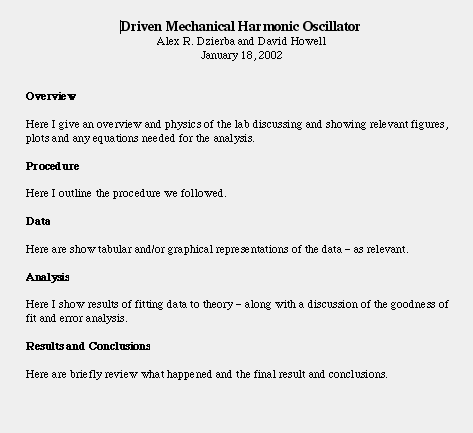
Note that the top of the report should include the title, authors' full names and date.
Before discussing the individual sections I want to note some general guidelines for technical writing:
- Your report should be written in a professional tone. Please do not make use of "cute or sarcastic language." It is not allowed in technical writing and I will deduct points from your report grade if I find this in your report. You should also write in the third person. Please pay attention to grammar and spelling. Note that the word data is a plural (of datum) noun, so, for example, it should be "data are analyzed" - NOT - "data is analyzed."
- Include drawings or photos if relevant. You are welcome to grab graphics from the Honors Course website or other websites for use in your report. If you use graphics from the web - please give a reference in the figure caption.
- Every figure (or table) should have a number and caption. Figures and tables have their own number sequence - start with Figure 1 and Table 1. The caption should be brief (one or two sentences) and descriptive enough. For example:
- Figure 1 - The amplitude of the oscillator of the oscillator as a function of frequency. The curve is a plot of the amplitude as a function of frequency as given by equation 1.
- Here are some guidelines for plots:
- Data points should be shown as markers (not lines between points).
- Make sure that points and text embedded in plots are readable.
- If several data sets (e.g. amplitude and phase) appear on the same plot, use different markers for different data and insert a legend. Do not rely solely on color to distinguish one type of data from another - it should be distinct when your report is printed on a B/W printer.
- Note that in IGOR it is possible to have two horizontal axes (one on top, the other bottom) and two vertical axes (left and right). This is useful when plotting, for example, amplitude and phase vs frequency on the same plot.
- The same applied to curves - if more than one curve appears on the plot use solid lines for one and dashed for the other.
- Label axes and include units.
- Each equation should have an equation number.
- In the text of your report - when you quote a number make sure it has units where appropriate. For fractional numbers explicitly insert the leading zero, i.e. write 0.051 not .051.