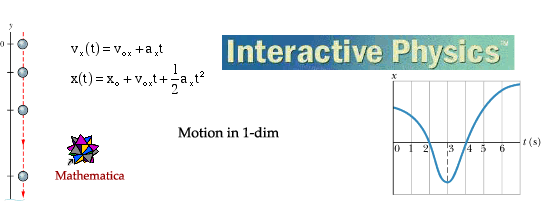
This semester we will cover mechanics and thermodynamics. That's it - in a nutshell - but now for more details.We will start by analyzing the kinematics of motion in 1-dimension - discussing the relationship among displacement, velocity and acceleration. You will also learn how to use Interactive Physics to simulate these kinematics and also learn how to use Mathematica to solve equations and plot relationships.
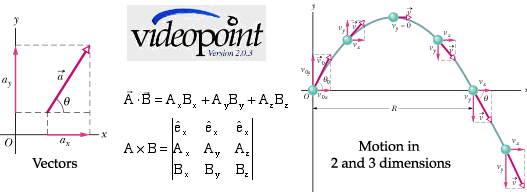
Motion will be described using vectors. We will introduce the concepts of vector addition and subtraction, multiplication of vectors by scalars and the notion of dot products and cross products. The motion of a projectile in two-dimensions will be analyzed and you will learn how to analyze movies of projectile motion (using VideoPoint) to measure the acceleration of gravity. Mathematica will be used to calculate the motion of a projectile when air resistance is present. We will also analyze projectile motion using Interactive Physics.
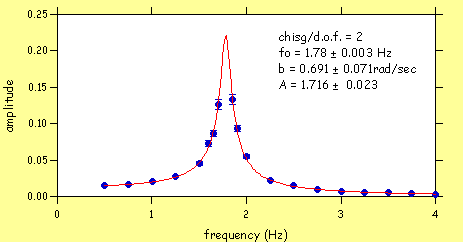
We will use motion detectors and other transducers interfaced to a computer to take data of mechanical systems. These data will be analyzed using the program IGOR - a powerful scientific spreadsheet that will allow you to plot data and fit the results to various functions to make cool graphs like this:
We will also discuss the importance of error analysis in making measurements and interpreting the results of measurements.
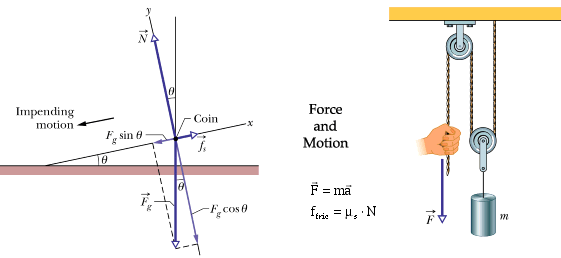
We will study dynamics of motion - what happens when a body is acted on by a force.
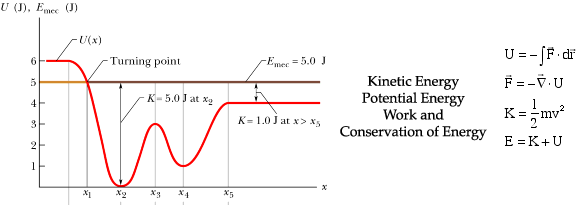
Conservation of energy is a powerful tool in understanding motion. We will study the inter-relationships among work, potential energy, kinetic energy and total energy.
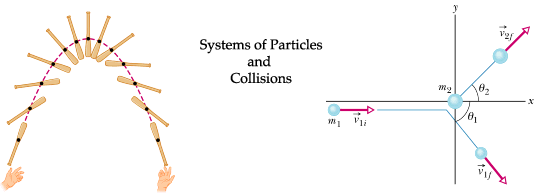
We will introduce the concept of 'center-of-mass' - learn how to calculate this for extended objects and then observe how the center-of-mass moves in response to the sum of all the forces acting on that system. We will also discuss conservation of momentum. Finally, we will also analyze collisions (elastic and inelastic) in one- and two-dimensions. Interactive physics will very useful here.
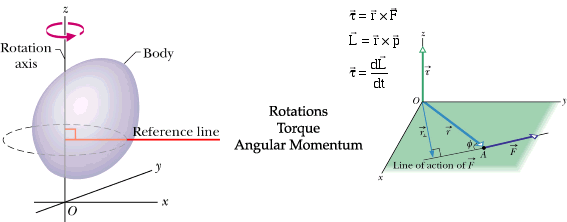
The kinematics of rotation will be introduced through the notion of angular displacement, angular velocity and angular acceleration. These are analogous to linear displacement, velocity and acceleration. And F=ma is replaced by an equation relating torque to the product of moment of intertia time angular acceleration. We will also discuss the important and fundamental concept of the conservation of angular momentum.
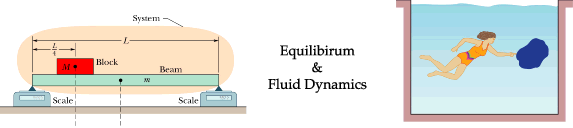
The topics of equilibrium and fluid dynamics are nice examples of applying the fundamental principles of mechanics to solve engineering problems.
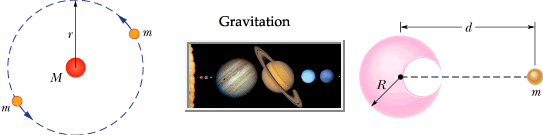
The gravitational force will be studied and we will examine the consequences of a force that falls off like distance squared and is radially directed. We will understand the basis of Kepler's laws and discuss the motion of the planets in our solar system.
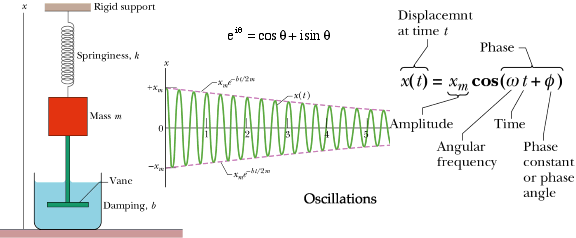
This is a rich topic - the analysis of oscillating systems and the mathematics that describes this. We will use Euler's equation to solve for damped and forced harmonic oscillations, study coupled oscillators and introduce you to the ideas of Fourier analysis.
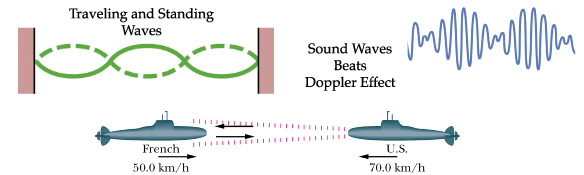
We will study transverse wave motion in a string under tension and then explore standing waves and the sound they produced. The mathematics of sound and water waves will be examined to explain beats, Doppler effect and shock waves.
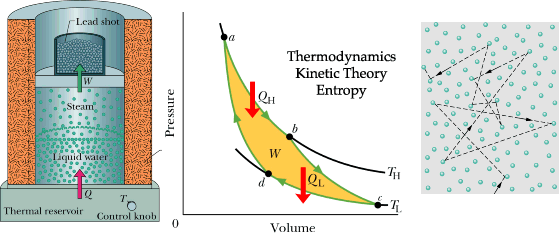
We will end the semester with a discussion of thermodynamics - the application of the laws we learned to systems with many particles. We will introduce the notion of temperature and how it is a measure of energy. The first and second laws of thermodynamics will be discussed - the kinetic theory of gases and the concept of entropy.