Rocket Problem
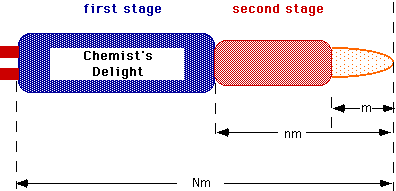
So in this problem we have a two-stage rocket where the masses are:
- payload: m
- payload + 2nd stage: nm [where n is an integer]
- payload + 1st and 2nd stage: Nm [where N is an integer]
and for each stage the mass of cannister to [cannister + fuel] = r
(a) Recall that the velocity boost for a rocket is:

where u is the exhaust velocity. For the 1st stage burn the initial and final masses are:
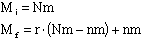
so we have this velocity after the 1st stage burn:
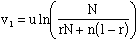
We note that if r = 0 (weight of the 1st stage cannister is negligible) then the velocity increment is just ln(N/n) - which makes sense and if r = 1 there is no fuel and the above gives ln(N/N) = ln(1) = 0 which also makes sense.
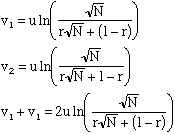
(b) For the 2nd stage burn the intial and final masses and velocity increment are:
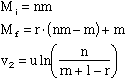
Again, the limits as r --> 0 and r --> 1 make sense.
(c) The total velocity is:

To find the value of n (holding N and r constant) that maximizes velocity involves taking the derivative of the argument of the ln function (the ln function is a monotonically increasing function of its argument) with respect to n. Use Mathematica:
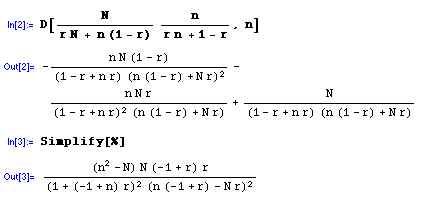
You see that the maximum occurs when n2 = N and note that when this is the case the two velocity increments are equal: