Special Problem
This problem is from A. P. French: Newtonian Mechanics. I modified it slightly.
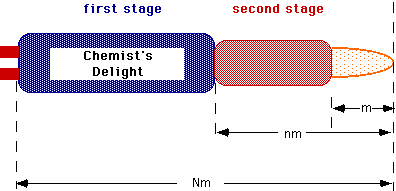
A two-stage rocket with a payload is shown. The mass of the payload is m. The mass of the second stage (fuel + casing) and payload is nm. That, is, nm is the mass immediately after first-stage burnout and separation. The mass of the entire rocket (both stages (fuel + casing) + payload) is Nm.
For each stage we have a casing mass (the final mass for that stage) and the fuel + casing mass (initial mass). Define r = (final mass)/(initial mass). The exhaust speed for the gases is vo.
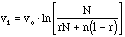
(a) Show that the velocity gained from the first-stage burn (assume we start from rest) is:
(b) Now find a corresponding expression for the additional velocity gained (v2) after the second-stage burn.
(c) Add v1 and v2 and this gives you the total payload velocity, v, in terms of N, n and r. Make N and r constants. Find the value of n for which v is a maximum.
(d) Show that the condition for v to be a maximum corresponds to having equal gains of velocity in the two stages. Find the maximum value of v. Verify that it makes sense for the limiting cases of r = 0 and r = 1.
(e) Find an expression for the payload velocity of a single stage rocket with the same values of N, r and vo.
(f) Suppose that it is desired to obtain a payload velocity of 10 km/sec, using rockets for which vo = 2.5 km/sec and r = 0.1. Show that the job can be done with a two-stage rocket, but it is impossible, however large the value of N, with a single stage rocket.