There are times when you want to solve for the motion of an object and the problem may be complicated enough so that an analytical solution does not exist or if difficult to come by. In this case a method of solving the problem numerically would be attractive. We will be solving a number of problems numerically in this course. This is very useful technique to learn and is the method used by simulation software - like Interactive Physics.
Our first problem will be pretty simple - one dimensional motion with a retarding force. Suppose an object is initially moving with some constant velocity vo and suddenly comes upon a viscous medium so that it experiences a retarding force proportional to velocity:

Note the minus sign (force and velocity vectors are antiparallel) and b is a constant which has the right units such that when multiplied by velocity will give units of force - so the units of b are mass/time (kg/sec).
The acceleration is then:

where we are explicitly noting that acceleration and velocity vary with time. Using:

we can solve for v(t):

or integrating both sides and remembering that v(t) = vo at t = 0 we get:

So in this case we can solve the problem analytically. We have an exponentially decreasing velocity which starts off with velocity vo and reaches zero at infinite time.
An interesting aside - even though the object takes infinite time to come to rest - it travels a finite distance - show this.
How would we solve this numerically ? Start with the fundamental notion of acceleration as a derivative of velocity:
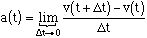
Assuming we have a small enough time interval:
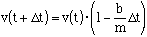
This tells us that if we know the velocity at some time we have a way to calulate it at a later time. For example, let's take the simple case of b/m = 1 and choose a time interval of 0.05 sec. If the velocity at t = 0 is vo, then the velocity at later times:
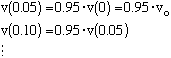
and so on. Got the idea ? So let's plot the results we get from the numerical solution and compare to the analytical solution:
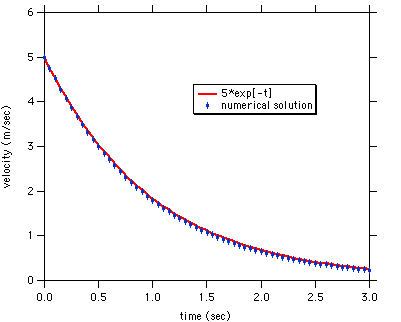
In this example we used vo = 5 m/sec.
You should use your calculator to verify these numbers and graph the analytical and numerical solutions on paper or use the graphing feature of your calculator. In one of the computer labs we will use Mathematica to do this problem.
Ponderables
Here are some questions for you:
1. What would happen if I doubled the time step ? quadrupled the time step ? How would the analytical and numerical solutions compare ? Can you think of some criteria for how fine a step size you need ?
2. Suppose the damping force had a form:

Does this have an analytical solution ? If so, what is it ? What are the units of c ? How do the numerical and analytic solutions compare with each other ?
3. How about a damping force like:
