
Parallel Axis Theorem
Imagine two axes that are parallel. One passes through the center of mass (CM) of an object of mass M whose moment of inertia about the CM is ICM. The other axis passes through some point P about which the object has moment of inertia IP. The distance between the axes is h. The theorem states that"
For example - the moment of inertia of a rod about an axis through the center is ML2/12 and about an axis through one end is ML2/3 and the separation between the two axis is L/2
Proof:
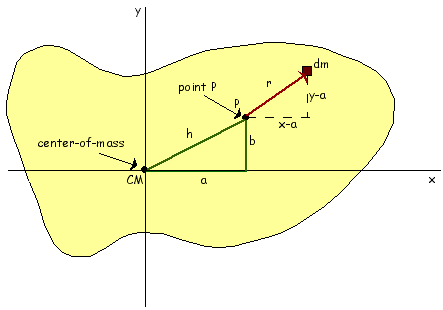
The origin of coordinates is at the CM. Now we want to compute the moment of inertia about point P so we sweep around the entire mass and each "chunk" of mass dm is located by vector r measured from point P. Point P is given by coordinates a and b and the distance between the CM and point P is h where:


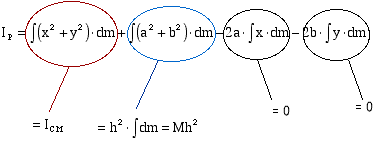
Theorem proved.