
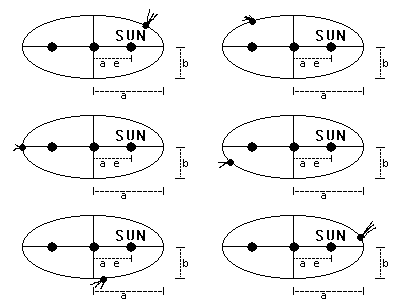
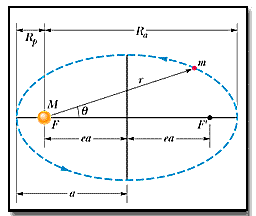
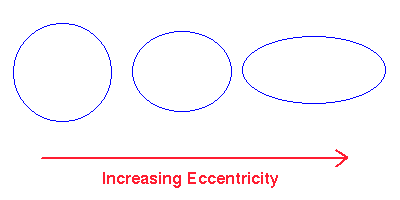
In the above figure e is the eccentricity. In the limit of e = 0, the ellipse is a circle.
If the horizontal and vertical axes are x and y respecitively and if the center of the ellipse is at the origin, the equation for the ellipse is:

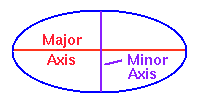
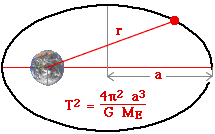
Where a is the semi-major axis and b the semi-minor axis.


Understanding why an ellipse for the orbit
Suppose we have a massive body (mass M ) fixed at the origin and another body (planet of mass m ) which is gravitationally attracted to the massive body but is otherwise free to move. Suppose the planet is initially at (x,y,z) = (xo,0,0). If we give the planet some velocity in the x-y plane then the planet will continue to move in the x-y plane. Why ? because angular momentum is conserved. The initial angular momentum is along the z-axis and since it is conserved, the velocity and position vector of the particle stay in the x-y plane. We need only two coordinates to describe the particle's trajectory: as shown in the figure.
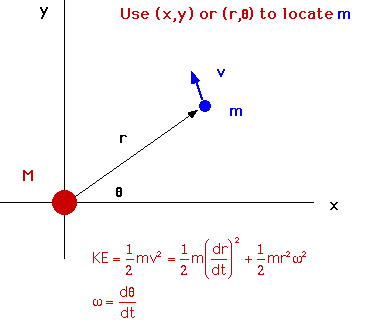
We will use energy (E ) and angular momentum (L )conservation in what follows. The total energy is a sum of kinetic plus potential energies:
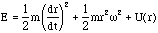
But since:

I can re-arrange the energy equation to look like:
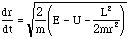
The quantity within the radical must be greater than or equal to zero. When the quantity is zero we have a turning point. How do we interpret the turning points ?
For simplicity we will work in a special world where GM = 1, m = 1, L = 1, all in the appropriate units. This will make our calculations easier. The relevant quantity in the above radical is then:
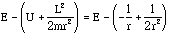
In the plot below, I show:
 in
black
in
black
 in
red
in
red
 in
blue
in
blue
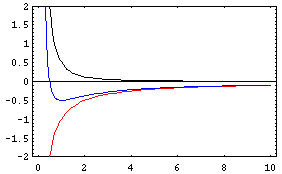 r
r
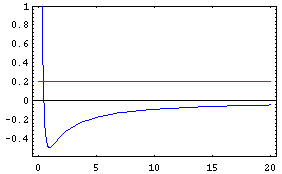
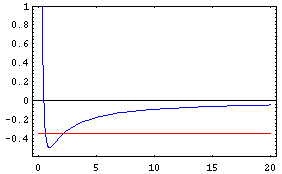
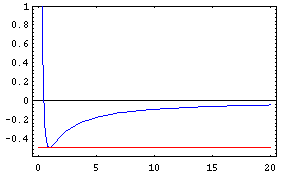
In the following plots I
show alone with
three possible values of total
energy
E
(in
red)
 E
= + 0.2 J
E
= + 0.2 J
 E
= - 0.35 J
E
= - 0.35 J
 E
= - 0.5 J
E
= - 0.5 J
In the first case we only have one truning point - the trajectory is a parabola. In the second case we have two turning points, with a distance of closest approach (perihelion) and farthest approach (aphelion). The orbit is an ellipse. In the third case there is one turning point - the orbit is a circle (only one value of r is possible.
For our special cae, the turning points are given by:
