 |
||||||
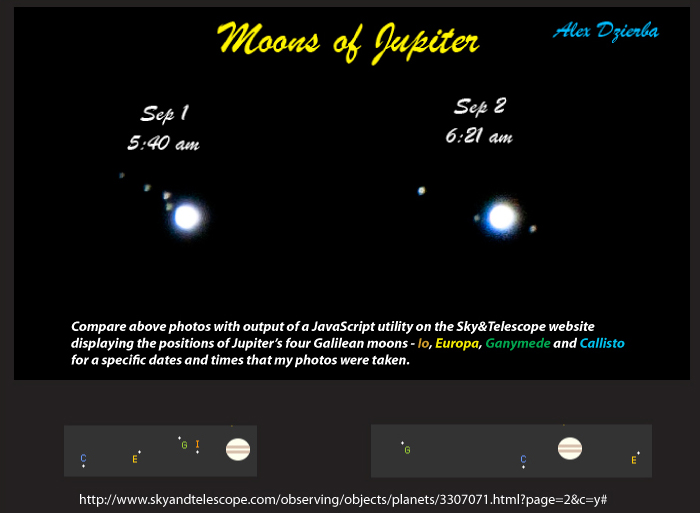
| The photos here were taken September 1 through 3. On each of these days I got up around 4 am to take some sky photos. On September 1 the sky was fairly clear and Jupiter was by far the brightest object in the sky. I used my Nikkor 70-300mm zoom lens @300mm. I examined some of my RAW format digital files and was surprised to see that I could make out the moons of Jupiter. After playing around with shooting at various ISO and shutter speed settings I settled on ISO 1250 and a shutter speed of 0.3 sec with maximum aperture (f/5.6). The shutter speed is fast enough so that the effect of Earth's rotation is minimized. | ||||||
 |
||||||
| The above show my photos of September 1 and 2. I discovered, during the evening of Sep 2, a nice JavaScript utility on the Sky&Telescope website (here). The utility allows one to enter the day and time and the output is a graphic showing the positions of the four Galilean moons. As you can see above - all four Galiliean moons were visible Sep 1 at 5:40 am.
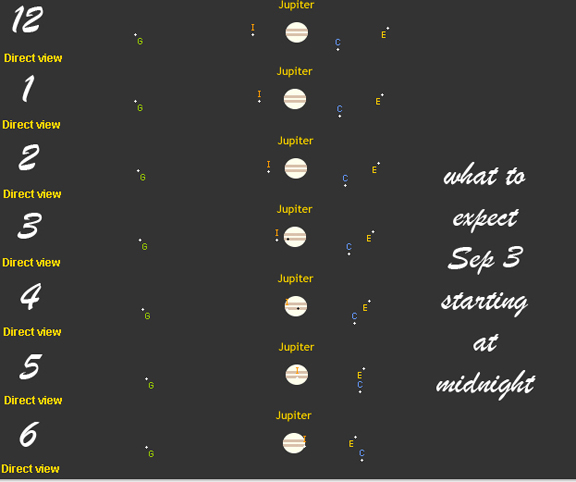
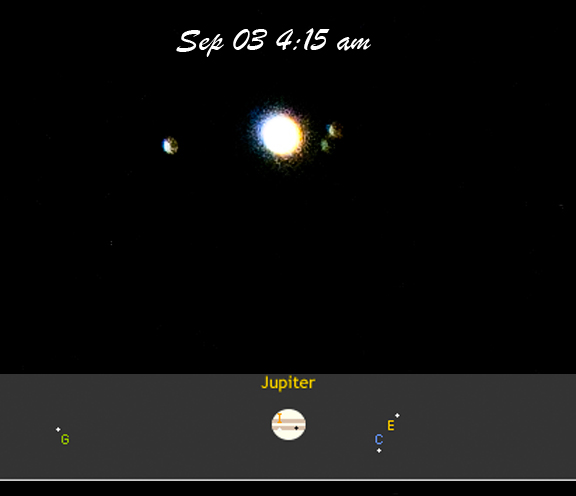
The periods of the moons are short enough (see this nice animation) to make for some interesting variations in the positions over the course of a viewing period. I had hoped to capture this for September 3, but incoming cloud coverage didn't allow for that. |
||||||
 |
||||||
 |
||||||