
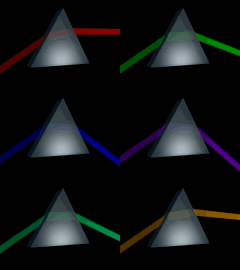
This course covers electricity and magnetism and optics. We will start by discussing the concept of electrical charge, the quantization of charge and the conservation of charge. Coulomb's law describes the behavior of the force between two charges. The force can be repulsive or attractive and varies with the product of the charges and inversely with the square of the distance. An electrical charge permeates the space around it with an electric field. We will use superposition to calculate the electric field due to an array of charges and then use Gauss' law to find the electric field due to various distributions of charges.


Electric fields can also be described by the electrical potential and the gradient of the potential along some direction specifies the component of electric field along that direction. In parallel we will discuss the relationship between electric current and potential in resistors and batteries and will discuss DC circuits. We will also discuss the relationship between charge and voltage in capacitors and will discuss how ciruits with resistors, capacitors and voltage sources behave.

Just as electrical charges set up electric fields, moving electric charges - currents - set up magnetic fields. Magnetic fields exert forces on other moving electric charges. We will discuss the principles of the operation of accelerators and the origin of the Earth's magnetic field. We will learn how to calculate magnetic fields due to different arrangements of currents.
Magnetic fields and electric fields are linked by Special Relativity. One can be viewed as a relativistic effect of the other. We will discuss the fundamentals of special relativity and some of its interesting consequences such as length contraction, time dilation and the implications of causality.
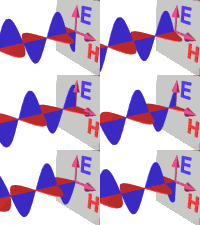
Remarkably, electric fields can be generated when the flux of magnetic fields varies with time. This has some important practical applications: generators and motors. Also, magnetic fields can be generated when the flux of electric field varies with time. These two phenomena are synthesized in Maxwell's equations that predict the generation of and propagation of electromagnetic waves. We will study these phenomena in A.C. circuits and the propagation of signals in transmission lines.
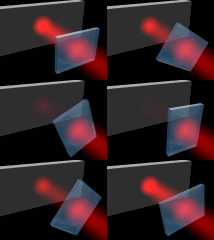
Light is an electromagnetic wave and Maxwell's equations explain the laws of reflection and refraction. We will use these to understand the behavior of lenses and prisms and systems of lenses: microscopes and telescopes. This field of optics is called geometric optics and has a nice description in terms of 2 x 2 matrices. From there we will use the wave nature of light to discuss polarization, interference and diffraction. Lab experiments using lasers, optical fibers and light sensors will allow us to quantitatively explore these phenemena.