Circuit 1
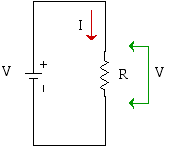
Suppose we have a voltage source, like a battery, connected across a resistor:
Circuit 1
The voltage across the battery is the same as the voltage across the resistor and the current through the battery is the same as the current through the resistor. The current (I) and voltage (V) are related by Ohm;s law:

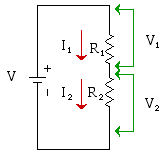
Now suppose we replace the resistor R with two resistors connected in series:
Circuit 2
Now the current through the battery (I) is the same as the current through each of the resistors but now the voltage across the battery is the sum of the voltage across one resistor and the voltage across the other resistor:

But Ohm's law applies for each resistor:

Or we can get a relation between V and I:

In other words, circuit 2 can be replaced by circuit 1 with a resistance given by:

Resistors in series look like a single resistor equal to the sum of the resistors.
From the above equations it is also easy to show that:

The total voltage (V) is divided between the resistors in the ratio of the resistances and circuit 2 is sometimes called a "voltage divider."
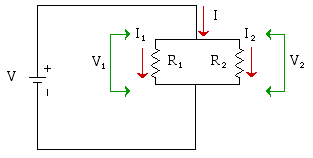
Now look at this circuit:
Circuit 3
Now we connect the two resistors in parallel with each other. Now the voltage across each resistor is the same as the voltage across the battery but the currents in the two resistors sum to give the total current through the battery. So for this circuit the currents add and voltages are the same whereas for circuit 2 the voltages add and the currents are the same.

or after re-writing:

or the two resistors in parallel can be replaced by a single resistance equal to:

Note that the equivalent resistance of two resistors in parallel is always less than either one. If the two resistances are equal, the equivalent resistance of the parallel combination is half of either resistance.
Not surprisingly, circuit 3 is a current divider and it is not hard to show that:

If both resistors have the same value, the current splits evenly. If R2 is infinitely large compared to R1, all the current will flow through R1 (current follows the path of least resistance).